-
- Note:
- These articles and images are copyrighted and may not be reprinted, re-used, reposted, copied, or otherwise distributed without permission from the author.
Disclaimer:
You should not rely on the veterinary advice or information provided on this site for diagnosis or treatment of any specific situation. Always consult your own veterinarian for specific advice concerning the medical condition or treatment of your own pet or animal.
|
A Bald Butt is the Least of an Adrenal Ferret's Woes
© Erika Matulich
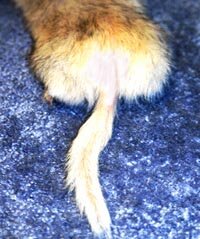
One day when Gizmo, my second ferret, was 3 years old, I noticed that her usually lush fur was thinner and duller. A week later, a bald patch appeared at the base of her tail and I noticed her vulva swelling, so off she went to the veterinarian. The diagnosis: adrenal disease.
This was the first of my many experiences with adrenal disease, which is quite common in American-bred ferrets. Some studies say that as many as 50 percent to 80 percent of American ferrets are affected. Female ferrets seem to be at higher risk. Ferrets can experience this problem any time in their life, but it's most common in those between 2 and 4 years of age.
Adrenal disease causes lesions or tumors on one or both adrenal glands. The adrenal glands—in ferrets as in humans—are complex organs (located near the kidneys) that produce certain sex hormones as well as secretions necessary for food metabolism, muscle maintenance, proper healing of wounds, and other important functions.
A benign glandular tumor is known as an adenoma; a malignant (cancerous) one is called a carcinoma. Fortunately, most adrenal tumors are benign. Unfortunately, even benign adrenal tumors cause problems for ferrets. In addition to losing their hair, adrenal ferrets lose muscle mass and have little energy.
There's lots of debate as to why adrenal disease is so common in American ferrets. One theory says that poor nutrition can lead to these tumors. Another blames inbreeding and a genetic pool that isn't very diverse. It's also thought that the early-alter practice (in which ferrets are spayed or neutered at 5 or 6 weeks of age) is a source of later adrenal problems. Finally, some people believe that artificial light cycles mess up the hormone cycle of ferrets, leading to adrenal problems.
The most common symptom of adrenal disease is “alopecia,” or baldness, usually starting at the butt. For Gizmo, hair loss progressed from her tail forward over the body until she had fur only on her head and feet. Males may lose hair starting at the neck. In spayed females like Gizmo, the vulva can become swollen.
Other common signs are increased itching and scratching, a potbelly, muscle wasting, orange skin patches, sexual aggressiveness (especially in males), and brittle fur. Sometimes you will also see a thinning of the skin, excessive drinking and urination, anemia, and weight loss.
To make things especially confusing, not all these symptoms are present in every case. I once noticed that Socks, another of my ferrets, was scratching more than usual. He showed no other symptoms, but an ultrasound test showed a large adrenal tumor.
Baldness or a swollen vulva are sufficient cause for immediate treatment. But if you're not sure (as with an itchy Socks), you can have an ultrasound performed by an experienced technician to detect a mass on the adrenals. Ultrasound is not entirely reliable, however; for instance, it can't detect very tiny tumors.
Another option for diagnosis is the ferret adrenal panel, available only at the University of Tennessee. For this test, your vet must draw blood, freeze it, and ship it under climate-controlled conditions to Tennessee. Then you have to wait for the results. Because of the expense involved with these two diagnostic tools, ultrasound and the adrenal panel should be used only for questionable cases.
The most common and effective treatment—and the only permanent one—is surgical removal of the entire affected adrenal gland. When an adrenal gland is diseased, it gets much larger, presumably because there are tumor cells on it; the vet can't really cut away only the bad part, because it's hard to tell what part that is.
For some undetermined reason, the left adrenal gland is affected more often than the right. This is a great source of relief to vets, because removal of the left adrenal gland is not an excessively difficult surgery and has a low risk of complication. Because the right adrenal is located near several large blood vessels, it can be difficult or even impossible to remove.
If both glands are affected, typically the left is removed and the right is “debulked,” a process by which the surgeon cuts away some of the glandular tissue. Aside from being risky, removing the entire right gland could lead to a hormone imbalance. Ferrets who have had both adrenal glands removed completely will require precortin injections (for hormone replacement) by a vet every few weeks for life.
If a ferret shows clear signs of adrenal disease but the vet cannot visually detect which gland is enlarged, the left gland is often removed on principle.
If the ferret is very old or in poor health, surgery may not be an option. Also, a ferret who has already had one adrenal gland removed might still be suffering from adrenal disease. For these ferrets, the problem can often be controlled (but not cured) with medication.
One option is Lysodren (mitotane), which must be given orally every three or four days without fail for the remainder of the ferret's life. Another option is the drug Lupron, given in monthly injections by a vet. (Stronger, twice yearly Lupron injections are another, but more expensive, option.)
Whether your vet recommends Lysodren or Lupron depends on the ferret and the situation. The drugs work in different ways. If the ferret is younger and you are on a budget, a vet may try Lysodren first (it's not cheap, but it's cheaper than Lupron).
But some ferrets don't respond well to Lysodren and experience nausea or no results. Also, Lysodren lowers the blood glucose level, so it would cause serious problems in a ferret who already has insulinoma (a blood-sugar regulation problem). Lupron is also recommended if a ferret's owners are not up to the medication regimen required with Lysodren.
My elderly ferret Slinky had already had his left adrenal gland removed and his right one debulked; he had been on Lysodren for several years when he quit responding to the drug (evidenced by another bald butt). He now gets injections of Lupron every six months.
Some owners don't wish to put their ferrets through the stress of surgery or are unwilling to spend the money. But drug treatments—aside from being less effective and having side effects—are just as expensive as surgery in the long run.
Adrenal ferrets who do not undergo surgery sometimes regrow their hair, but this does not mean the adrenal tumor has gone away. Adrenal disease is cumulative and progressive. And although the tumors don't appear to be painful, the other problems associated with this disease greatly decrease the quality of a ferret's life.
Without surgery, your ferret can live bald and relatively happy for six months to two years; with surgery, she can live a full life span (eight years on the average) with good health.
Ferrets up to 6 years old are considered good candidates for surgery, and recovery time is quick (all of my ferrets have recovered within two weeks). Also, during exploratory surgery the vet can look for other common diseases such as insulinoma, spleen problems, or cysts. When my Little Bear was having her “routine” adrenal surgery, the surgeon found that part of the tumor was threatening to choke off her kidney. Had I postponed or forgone the surgery, Little Bear could have died from renal failure.
Having been through dozens of adrenal tests, surgeries, and medication regimens, I always hope that the next ferret will stay healthy. But adrenal disease is common, and dealing with it comes with the territory of sharing your life with ferrets. My husband and I start a savings account for each new ferret so that we will be financially ready if and when the time for adrenal treatment comes. We think our ferrets are worth it!

Adrenal disease and light cycles
Because there is some evidence that artificial light cycles can mess up the hormone cycle of ferrets and lead to adrenal problems, I am careful to keep my ferrets on a natural light cycle.
The large closet where the cages are has a timer on the light. When the sun goes down, that room is dark. When the sun comes up, it is lit. Other rooms that the ferrets use during the day have natural light from windows, and when the ferrets are out of their cages, we try (as much as possible) not to use artificial lights to “overcome” the natural light level.
|
|